

Many of us have had enough politics, so I’m not going to start a column for “Privacy Dispatch” by wading into it. You can make up your own mind about World Liberty FInancial, the crypto outfit co-founded by several members of the Trump family.
I want, instead, to focus on a particular aspect of Jen Wieczner’s terrific New York Magazine feature about WLFI and the complaints of Justin Sun, the fabulously wealthy founder of TRON.
According to Sun, eight days before $WLFI began trading, World Liberty pushed a change to its smart contract that let the company freeze (and effectively seize) any wallet it chose, without warning. Sun says he woke up locked out of roughly $776 million in tokens.
Sun wrote on X that it was "a trap door marketed as an open door."
According to Sun, WLFI reprogrammed a smart contract on the eve of trading to allow it to control any assets on the blockchain.
WLFI, let’s not forget, adopted all the grand language of decentralization when it announced itself. It promised uncensorable wallets, self-custody, and escape from the banks that "debanked" its founders. Then, according to Sun, it shipped the one feature banks have and crypto is supposed to end: a switch someone else can flip on your money.
This is why I keep saying the interesting question isn't whether a system has privacy, or even whether it's "onchain." It's where control lives.
Everything real about crypto is decided at the contract level, in code that either runs the same way for everyone or quietly reserves an exception for whoever holds the keys.
Privacy is the same story. It's either built into the architecture in the user's interest, or it's a veneer over a mechanism designed to pull a “fast one” (as they say in London).
Miden, of course, is very different.
In the World Liberty design, your tokens live on a ledger the operator can rewrite. The admin key is the product.
In Miden's design, an account's state lives on your device; what touches the chain is a commitment (a hash) and a validity proof you generate client-side. There's no central ledger of everyone's balances for an operator to reach into, because the network never held that view of your assets in the first place.
In other words, control isn't granted by policy and revocable by policy. It's a property of where the data sits and who can prove things about it.
I'll be careful not to overclaim here: architecture doesn't make anyone virtuous, and compliance still matters (Miden's answer is programmable controls the user carries, not a chaperone who carries them).
But architecture does decide what's possible. Your system either has potential for backdoors, and backsliding, or it doesn’t. My advice: check what kind of blockchain system you’re getting into.
Privacy Roundup
Zama launched the private beta of Confidential RFQ on Ethereum, using fully homomorphic encryption (FHE) to conceal trade intent, direction and size while processing transactions onchain.
Aztec activated Alpha V5, reducing native private-transfer proving time from 5.2 seconds to about 2.5 seconds and launching Shield by human.tech, a compliance bridge, alongside the Azguard browser wallet.
Aleo and Paxos Labs highlighted USAD, the privacy-preserving stablecoin integrated into Toku’s payroll platform, allowing employers to pay global teams without exposing salary, recipient or treasury data.
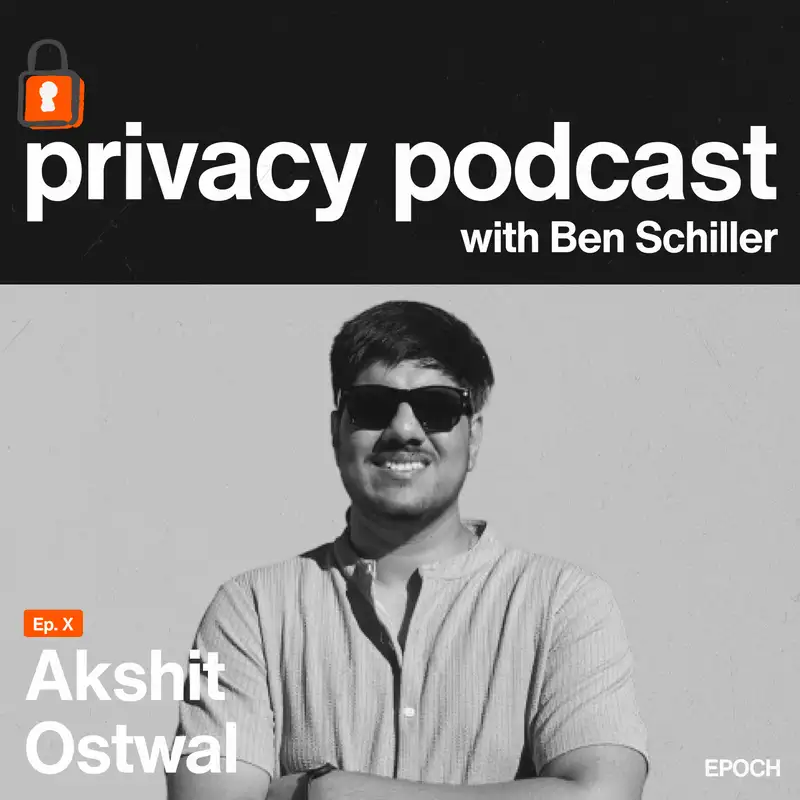
Akshit Ostwal on Privacy Podcast
In this episode of the Privacy Podcast, host Ben Schiller speaks with Akshit Ostwal, co-founder of Epoch Protocol, about intents, solver networks, and a simpler UX for onchain finance. The conversation also explores Epoch’s work with Miden, where programmable privacy brings a new dimension to intent-based infrastructure.
Akshit explains that users do not care about bridges, swaps, or the mechanics behind a transaction. They care about outcomes: moving assets, making payments, accessing yield, or using an application without navigating every step themselves.
Intent-based infrastructure is designed to make that possible. Listen on Apple Podcasts and Spotify to learn how it works.
Thanks for reading this edition of Privacy Dispatch. Please subscribe to receive this newsletter every Tuesday.
Till next time.