

Sui, Aptos and Miden all share a big thing in common. Their foundational technology was all initially developed at Facebook (now Meta), specifically its now-defunct Libra/Diem stablecoin project. They come from the same research culture, the same engineering instincts, the same foundational work on the Move language and zero-knowledge systems. Sui (launched in 2023) and Aptos (2022) have become top chains since, with hundreds of millions in market cap.
Miden launches on Mainnet in 2026, hoping to achieve the same.
And here's the thing. All three are converging around a basic thesis: that privacy on public networks is key to achieving wider corporate adoption of blockchain technology.
Last week, Sui's co-founder and CPO Eman Abio outlined where the network is heading: default privacy for users, compliance when necessary, and full compatibility with the financial system. Not privacy or compliance. Both. The framing matters because it retires an argument that has dominated the space for years: that chains had to choose between being useful to regulators and being useful to users.
Aptos has made the same bet more concretely. Confidential APT launched on its mainnet following near-unanimous governance approval. It uses zero-knowledge proofs to allow balances and transfer amounts to be hidden while keeping transactions verifiable. Unlike privacy coins such as Monero, Confidential APT keeps wallet addresses and transaction verification data visible while concealing sensitive details like token balances and transfer amounts. It’s a distinction designed to maintain the transparency crucial for enterprise adoption and compliance.
Aptos founding engineer Sherry Xiao, who worked on Meta's Libra/Diem team, put it plainly: users currently have two options: public chains like Bitcoin that expose everything, or privacy chains like Monero that hide it. The second option faces regulatory pushback and shuts out institutional users who need private yet compliant infrastructure. Confidential APT is an attempt to close that gap at the protocol level.
Meanwhile, Aptos is also developing an encrypted mempool: a major upgrade pending governance approval that would deliver full transaction intent confidentiality at the protocol level, protecting users from front-running, censorship, and order-flow leakage while preserving network speed.
The convergence is not a coincidence. These teams share a design philosophy: that privacy implemented at the infrastructure layer, with selective disclosure built in from the start, is the only model that survives contact with both regulators and users at scale. Every workaround that treats privacy as an add-on has limits. The Meta lineage chains are betting on architecture over retrofitting.
Miden is part of that story. The difference is that Miden is building with zero-knowledge proofs as the foundation rather than layering them on top. That means the compliance model isn't a constraint on the privacy model. They're the same thing. Every transaction is private by default; compliance is a disclosure decision, not a rebuild. That's the claim the market is now beginning to price in across all three networks.
The question of whether crypto can reach billions of users is, increasingly, a question about whether privacy infrastructure gets built correctly. The teams that came out of Meta seem to think they already know the answer.
Privacy Roundup
Dynamic announced support for private payments powered by Aleo, letting users log in with an email and pay anyone privately — removing the wallet infrastructure barrier that's kept mainstream businesses off private payment protocols.
Zama acquired TokenOps, a token distribution and vesting platform that has processed over $2B, to enable confidential distributions and vesting with encrypted onchain amounts via Zama's FHE protocol.
Trezu launched confidential treasuries, letting teams run treasury, payroll, and transactions fully private onchain across 35+ chains using secure hardware enclaves, powered by NEAR Protocol.
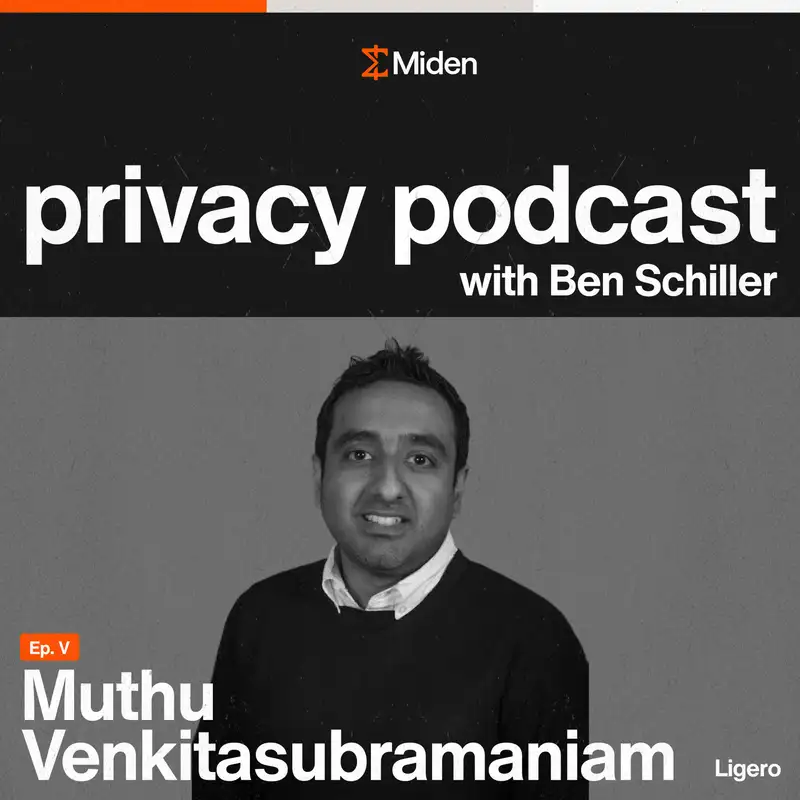
Muthu Venkitasubramaniam on Privacy Podcast
In this episode of The Privacy Podcast, Ben sits down with Muthu Venkitasubramaniam, CEO of Ligero and Georgetown professor, to discuss the evolution of Zero-Knowledge (ZK) technology.
The conversation highlights a shift toward self-sovereign compliance — where ZK proofs let users meet regulatory requirements without giving up personal privacy — with implications for digital payroll, composable finance, and private on-chain transactions.
Thanks for reading this edition of Privacy Dispatch. Please subscribe to receive this newsletter every Tuesday alongside new episodes of the Privacy Podcast.
Till next time.