

How big is the tokenization opportunity? $8.2 trillion, potentially.
That’s the bull case estimate from last month's Citi Institute report, Tokenization 2030: Wall Street Onchain, one of the first to quantify the process of turning the world’s traditional assets into tokenized assets.
Citi projects tokenized financial assets growing from roughly $17 billion today to $5.5 trillion by 2030. Or $8.2 trillion in the bull estimation.
The forces behind this are converging: the DTCC, NYSE, Nasdaq, Blackrock, and leading market infrastructure companies, are embedding tokenization into core market plumbing. A projected $1.9 trillion stablecoin float is providing onchain settlement money. And regulatory clarity is arriving across jurisdictions.
What about privacy?
Well, it’s nowhere and everywhere in the report.
Across 50 pages of market modeling, adoption curves and risk analysis, privacy is essentially a footnote. It doesn't appear in the six key takeaways. It plays no role in the $5.5 trillion math. The risks section covers settlement risk, ownership ambiguity, fragmentation and systemic concentration. Transaction-level transparency is actually listed as a revenue opportunity.
But, when asked to name the single biggest bottleneck in the entire stack, Brevan Howard Digital CIO Chris Rayner-Cook said: a universal digital identity standard, "particularly when combined with privacy."
Regulated institutions must verify counterparties without exposing sensitive information onchain, and until identity, compliance and privacy are balanced, he argues, institutional participation stays constrained by regulation rather than technology.
That’s why early institutional tokenization has retreated to private permissioned chains; those were the environments that offered privacy. But, then, is it really a blockchain, meaning trading openness and liquidity?
The report's bottleneck and its adoption story both point at privacy. But the forecast doesn't really model it, it seems.
The companies building privacy infrastructure have noticed.
Matter Labs has now completed one of the starkest pivots in crypto: zkSync, once a general-purpose Ethereum L2, is today an enterprise vendor selling Prividium: licensed, permissioned private chains that banks run inside their own infrastructure, anchored to Ethereum by ZK proofs. The company cut staff again last month to align fully behind it, and its 2026 roadmap declares privacy by default a non-negotiable standard. Canton Network raised $355 million on the same thesis and holds the deepest TradFi logo sheet in the industry.
The big question is not whether privacy gets adopted onchain by the institutions. It is: what sort? None of it scales until privacy is solved. And the industry, including Miden, is now competing over what "solved" means.
There are two ways to read "solved." One is privacy behind closed doors: permissioned chains that are blockchains mostly in name. The other is privacy on open networks: where verification stays private, even if the market doesn't.
I’ll bet you — because the history of the internet mostly proves it — that the open networks win eventually. Closed systems are great for pilot runs. An $8.2 trillion estimate requires open markets.
Privacy Roundup
Stellar shipped confidential tokens to testnet, hiding balance and transfer amounts on any SEP-41 asset including USDC while keeping addresses visible.
Zama's encrypted cUSDC crossed $10M in deposits on Steakhouse within four days of launch, earning the same rate as the public vault while keeping balances and transactions private.
ZKsync's Prividium now supports Hyperledger Besu, giving institutions ZK-proven privacy and direct Ethereum settlement without architecture migrations. In testing with several institutions, with first deployments expected later this year.
Umbra shipped private payroll in USDC, securing onramps and offramps through its Onramper integration so salary details and payment timing stay off public view.
Fhenix acquired Sunscreen, an applied cryptography startup, to accelerate FHE for institutional finance — with Sunscreen founder Ravital Solomon taking over research at Fhenix.
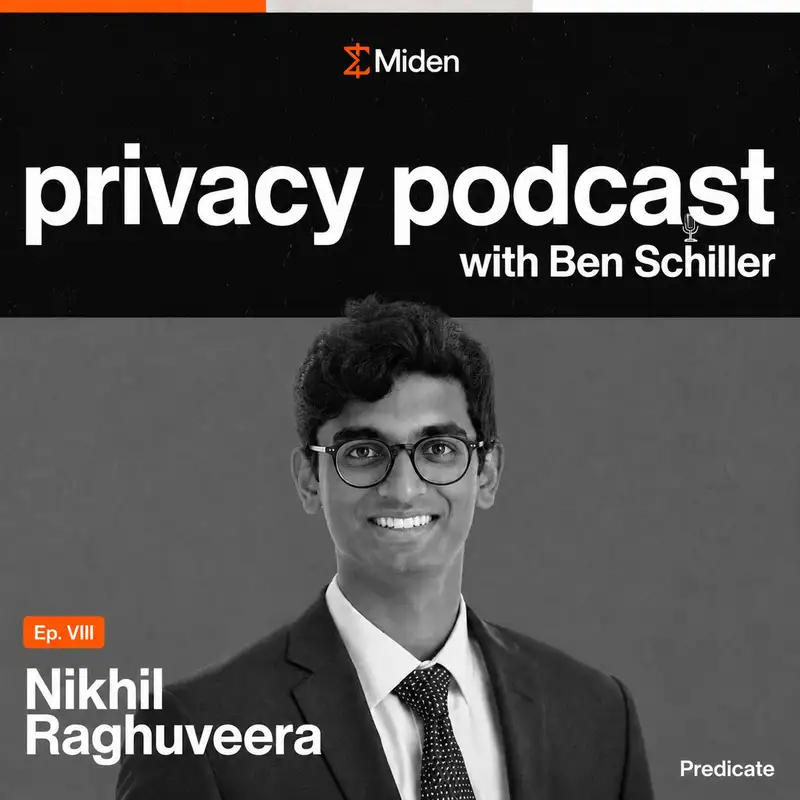
Nikhil Raghuveera on Privacy Podcast
In this episode of the Privacy Podcast, Ben sits down with Nikhil Raghuveera, co-founder and CEO of Predicate, to discuss how programmable compliance is reshaping onchain finance without sacrificing blockchain's core privacy principles.
The conversation reframes privacy and compliance as complementary rather than opposing sides, and zero-knowledge proofs offer a way to meet regulatory requirements while collecting far less personal data.
On adoption, Raghuveera sees two paths for ZK: either businesses adopt it voluntarily and regulators affirm it, or regulators mandate it because the public demands it.
Thanks for reading this edition of Privacy Dispatch. Please subscribe to receive this newsletter every Tuesday.
Till next time.